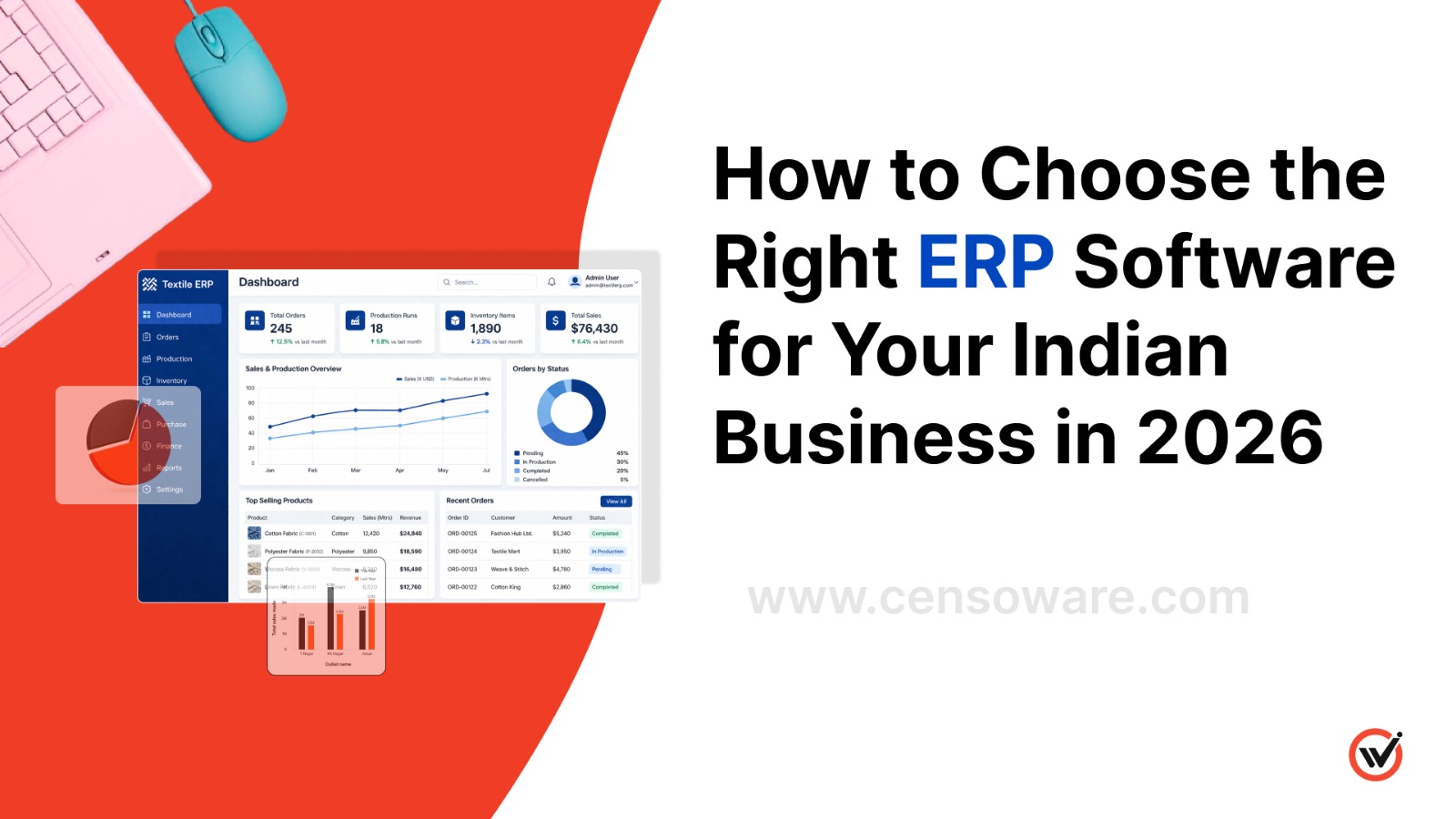
How to Choose the Right ERP Software for Your Indian Business in 2026
A practical, no-nonsense guide to navigating the Indian ERP market so you pick the right system the first time.
- 6 Things to Look for When Choosing ERP Software in India
- ERP Software for the Textile Industry
- ERP Software for Schools
- Questions to Ask Any ERP Vendor Before Signing
- ERP Pricing Reference — Indian Market 2026
- Frequently Asked Questions
ERP software can transform your operations but choosing the wrong system is costly and hard to reverse. With so many vendors in the Indian market, it's easy to feel overwhelmed.
This guide helps you cut through the noise, ask the right questions, and choose an ERP that fits your business.
What Exactly Is ERP Software, and Why Does Your Business Need It?
ERP (Enterprise Resource Planning) is a single system that connects your core business functions like finance, inventory, and sales - in one place. Without ERP, businesses rely on disconnected tools, leading to data gaps, delays, and errors.
With the right ERP, your team works from one source of truth. Reports are instant. Compliance is easier. Decisions are data-driven.
Why it matters in India: GST compliance, multi-location operations, and seasonal demand make integrated software essential for growing SMEs.
6 Things to Look for When Choosing ERP Software in India
Not all ERP systems are built the same. Here are the six most critical factors for Indian businesses to consider when evaluating their options.
1. Industry-Specific Features
A generic ERP built for a global manufacturing giant will not serve a mid-size textile exporter or a CBSE school in Tamil Nadu. Look for a system designed or deeply customised for your sector.
Ask vendors: Does your ERP handle the workflows specific to my industry out of the box, or will I need to pay for expensive customisation?
2. Cloud vs On-Premise
Cloud ERP is hosted on the vendor's servers and accessed via browser or app. On-premise ERP is installed on your own hardware. For most Indian SMEs, cloud ERP is now the better choice:
- Lower upfront cost - pay monthly or annually
- Accessible from any location - important for multi-branch operations
- Automatic updates and backups
- Works even with mid-tier internet connectivity
On-premise may suit businesses with strict data sovereignty requirements or in regions with unreliable connectivity.
3. Ease of Use and Training
An ERP your team won't use is worthless. Check usability early - can your team use it with minimal training? Always ask for a live demo with real workflows.
Pro tip: Request a free trial or sandbox account. Have your actual end users test it for 30 minutes before you commit.
4. Local Language and Compliance Support
Your ERP must support GST filing, e-invoicing (IRN/QR), TDS, and state-specific compliance requirements. Tamil, Hindi, and regional language interfaces are a significant advantage for front-line staff.
Verify that the vendor has a GST-ready module that auto-generates GSTR-1, GSTR-3B, and reconciliation reports.
5. Integration with Existing Systems
ERP systems don't operate in isolation. They should integrate seamlessly with your existing tools such as Tally, Zoho, WooCommerce, payment gateways, courier APIs, and CRMs. Before committing, make sure the system supports the integrations your business relies on.
6. After-Sales Support
This is where many ERP purchases in India go wrong. Vendors are highly responsive during the sales process, but often fall short after implementation. Ask specific questions upfront:
- Is support available in Tamil or Hindi?
- What are the support hours — business hours only or full 24×7 coverage?
- Is there a dedicated implementation consultant, or will support be handled through a ticketing system?
- What is the average resolution time for critical issues?
ERP Software for the Textile Industry - What to Look For
The Indian textile industry has unique operational needs that generic ERPs often can't handle. If you're in this space, your ERP must support:
- Greige and finished goods inventory tracking by colour, count, construction, and weave
- Job work and outsourcing management - dyeing, printing, and embroidery
- Yarn procurement planning based on production orders
- Export documentation - packing lists, shipping bills, and LC management
- Shrinkage and wastage tracking at each production stage
- GST on textile goods with HSN code mapping
A textile ERP that lacks these capabilities will force your team to maintain parallel manual records — defeating the purpose entirely.
Censoware's Take: Built for Indian Textile Businesses
Censoware Textile ERP is built specifically for Indian textile businesses, covering the entire production cycle from yarn procurement to dispatch with built-in GST compliance. It provides better visibility into operations, reduces manual work, and keeps your processes aligned with local regulations. Learn more at censoware.com/products.
ERP Software for Schools - Features That Matter
Schools have different operational needs than businesses. A School ERP should cover:
- Admission management and online application processing
- Fee collection, receipts, and defaulter tracking
- Student attendance - biometric, RFID, or manual entry
- Timetable scheduling and staff management
- Examination marks and report card generation
- Parent communication via SMS and app notifications
- Library, transport, and hostel module integration
Beyond features, look for a school ERP that complies with state board and CBSE reporting requirements and supports the academic calendar structure used in Tamil Nadu or your target state.
Censoware's Take: Designed for Indian K–12 Schools
Censoware School ERP is designed for Indian K-12 schools with a focus on ease of use for non-technical staff. Explore features at censoware.com/products.
Questions to Ask Any ERP Vendor Before Signing
Before you commit to any ERP system, put these questions to the vendor in writing:
- How many businesses in my industry and state are currently using your ERP?
- Can you provide references from companies of similar size and sector?
- What is the total cost of ownership over 3 years, including implementation, training, and support?
- How long does implementation typically take, and what does the project plan look like?
- Does the software include GST updates at no additional cost?
- What happens to our data if we decide to stop using your software?
- Do you offer data migration from our current system?
Vendors who are reluctant to answer these questions transparently are a red flag.
ERP Pricing Reference — Indian Market 2026
ERP pricing in India varies by vendor, users, and features. Always ask for the total cost of ownership including implementation, training, data migration, and maintenance before comparing prices.
ERP Software Pricing in India — By Business Size
| Business Size | Monthly Cost (INR) | Typical Use Case |
|---|---|---|
| Small Business | ₹2,000 – ₹5,000/month | Basic finance, inventory, GST |
| Mid-Size Business | ₹8,000 – ₹30,000/month | Multi-module, multi-user, integrations |
| Enterprise / Custom | ₹30,000+/month | Full customisation, dedicated support |
One important note: implementation, training, data migration, and annual maintenance are often not included in the base price. Always ask for a complete 3-year cost estimate before signing.
Frequently Asked Questions
What is the cost of ERP software in India?
ERP pricing in India varies by vendor, users, and features. Small business plans start around ₹2,000–₹5,000/month, mid-size solutions range from ₹8,000–₹30,000/month, and custom enterprise systems can cost significantly more. Always ask for the total cost of ownership including implementation, training, data migration, and maintenance before comparing prices.
How long does ERP implementation take?
ERP timelines vary by complexity — simple setups take a few weeks, mid-level implementations take a few months, and larger systems can take several months. Implementation timelines depend largely on your readiness — clean data, trained staff, and a clear process owner can significantly speed things up.
Do I need a cloud ERP or an on-premise ERP?
For most Indian SMEs, cloud ERP is the better choice in 2026. It has lower upfront cost, works across multiple locations, and receives automatic GST and compliance updates. On-premise ERP may suit businesses with strict data sovereignty needs or those operating in areas with poor internet reliability.
What is the difference between a generic ERP and an industry-specific ERP?
A generic ERP is built to serve many industries with broad, configurable modules. An industry-specific ERP like a textile ERP or a school ERP comes pre-built with the workflows, compliance rules, and terminology specific to that sector. For most Indian SMEs, an industry-specific ERP requires less customisation, costs less to implement, and delivers faster value.
What hidden costs should I plan for beyond the ERP subscription?
The primary additional costs include implementation and setup fees, data migration from your existing system, staff training, ongoing GST update modules, and annual maintenance. It's advisable to budget approximately 20-30% of your first-year subscription cost for these additional expenses.
Ready to Choose the Right ERP for Your Business?
Choosing an ERP system is one of the most important technology decisions your business will make. The right system streamlines operations, reduces errors, and gives you real-time visibility into your business. The wrong system wastes months of effort and thousands of rupees.
Censoware provides industry-specific ERP solutions for Indian businesses, including Textile and School ERP, supported by hands-on implementation, training, and ongoing support. Visit censoware.com/products to speak with an expert.